
She Thought Her Hormones Were the Problem. The Real Story Was Much More Interesting.

One of the biggest misconceptions I see in clinic is women believing they have a hormone problem.
Now don't get me wrong, sometimes they absolutely do. Their periods are irregular, they're exhausted, they're struggling with weight gain, their skin is breaking out, their moods are all over the place, or they're having difficulty conceiving. But after years of working in this space, I've learnt that hormones are often the messenger rather than the problem itself.
BOOK A CONSULTATION
Recently, I was reviewing the case of a 32-year-old woman who had completely lost her menstrual cycle. She'd gained weight, her energy was low, and despite doing all the things she thought she should be doing, she felt like her body was working against her. She'd had blood tests. She'd tried supplements. She'd tried eating healthier. She'd tried exercising more. Yet nothing seemed to be shifting.
And honestly? That's often when women find their way into my clinic.
Not because they haven't asked for help.
But because they've asked for help and still don't have answers.
What fascinated me most about this case wasn't that her hormones were low. In fact, low hormones were almost expected given her symptoms. What interested me was understanding why they were low in the first place.
Because hormones don't just wake up one day and decide to stop working.
Something influences them.
Something drives the change.
Something creates the environment where the body begins adapting differently.
And that's where things start to get really interesting.
When we dug deeper into her case using functional testing, the picture became much more complex than a simple hormone imbalance. Yes, her reproductive hormones were low, but that wasn't the most significant finding. What stood out was the amount of physiological stress her body appeared to be under. Her cortisol pattern suggested her nervous system had been operating in a heightened stress state for a long time, her melatonin levels were low, and there were signs that her detoxification pathways were under significant pressure.
One of the first things I explain to women in clinic is that hormones don't exist in isolation. Well, I tell ya what sis, they don't. Hormones are constantly communicating with every other major system in the body. Your gut influences your hormones. Your immune system influences your hormones. Your brain influences your hormones. Your stress response influences your hormones. Even the environment you're living in can influence your hormones.
This is why I get a little frustrated when women are told that their hormones are "fine" simply because one blood test came back within the reference range.
Hormones are responsive. They're constantly gathering information about what's happening inside the body and adjusting accordingly. If a woman is experiencing chronic stress, poor sleep, nutrient deficiencies, inflammation, gut dysfunction, environmental exposures or metabolic dysfunction, her hormones will respond to that information.
They're not operating independently of it.
Looking at this woman's results, I wasn't seeing a body that had simply stopped working. I was seeing a body that appeared to be adapting to a number of different stressors all at once. From a physiological perspective, it made sense that ovulation had become less of a priority. The body was trying to manage stress signalling, recovery, inflammation and environmental burden. Reproduction had quietly moved further down the priority list.
And when you understand that, a lot of symptoms suddenly start making sense.
One of the most common examples I see of this is weight gain. Women often blame themselves when weight starts increasing. They assume they're not trying hard enough, they're eating too much, they're lacking motivation or discipline. Yet many of the women I work with are some of the most disciplined people I know. They're exercising. They're eating well. They're trying incredibly hard.
The problem is that sometimes we're looking at weight gain as the cause when it's actually part of the symptom picture.
If cortisol is elevated, sleep quality is poor, inflammation is present, insulin sensitivity is impaired and hormone production is compromised, the body becomes significantly more resistant to change. It isn't necessarily a lack of effort that's standing in the way. It's biology, and biology will always win.
Another aspect of this case that caught my attention was the evidence of environmental burden. Now before anyone runs off and throws away every plastic container in their kitchen, that's not what I'm suggesting. The goal isn't perfection and it's certainly not fear. The reality is that every single one of us is exposed to environmental toxins in some capacity. They're in our food packaging, our water, our personal care products, our household products, the air we breathe, the furniture we sit on and even some of the foods we eat.
BOOK A CONSULTATION
What we're learning through research is that some of these compounds can act as endocrine disruptors, meaning they can interfere with the way hormones communicate with cells. Some can mimic hormones, some can block hormones, and others can influence how hormones are produced, metabolised or eliminated. Over years and decades of exposure, this can contribute to the picture we see in clinic, particularly in women struggling with fertility, menstrual irregularities and metabolic health challenges.
What many people don't realise is that our toxin story often starts long before we're born.
During pregnancy, a mother's exposure to environmental toxins can cross the placenta and influence the developing baby. In simple terms, we don't all start life with the same environmental load. Some people enter the world with a greater toxic burden than others, simply because of the environment their mother was exposed to during pregnancy. We now know that compounds such as BPA, PFAS (often referred to as "forever chemicals"), pesticides and heavy metals can be transferred from mother to baby during development.
This is one of the reasons environmental medicine fascinates me so much. Two women can appear to be living very similar lifestyles, eating similar diets and following similar health habits, yet one seems to tolerate environmental exposures relatively well while the other develops significant symptoms. Part of that comes down to genetics, but genetics are only one piece of the puzzle. Nutritional status, liver function, gut health, detoxification capacity, hormone health, stress resilience and even prenatal exposures all influence how effectively the body can process and eliminate toxins.
Think of it like a bucket.
One woman may have started life with a relatively empty bucket. Another may have started life with the bucket already half full. Then over the next 20, 30 or 40 years they accumulate additional exposures from food, water, plastics, cosmetics, medications, mould exposure, air pollution and countless other sources. Eventually some women reach a point where the bucket starts overflowing and symptoms begin appearing.
Those symptoms don't always look like what we'd traditionally associate with toxicity either.
They can show up as fatigue, brain fog, weight gain, poor sleep, fertility challenges, PMS, irregular cycles, migraines, skin issues, anxiety, low mood or simply feeling like your body isn't functioning the way it once did.
One of the most fascinating areas of research is the relationship between environmental toxins and female hormones. Certain compounds have been shown to interact directly with estrogen receptors, essentially sending confusing signals throughout the body. Others can influence ovarian function, affect egg quality, alter hormone production pathways, impair thyroid function or increase oxidative stress and inflammation.
BOOK A CONSULTATION
Some environmental toxins can behave a little like unwanted guests at a party. They show up where they're not invited and start interfering with conversations that should be happening between your hormones and your cells. Others can block receptors entirely, meaning hormones are produced but their messages don't get received properly. Some have even been shown to influence DNA methylation, which is one of the mechanisms involved in regulating how genes are expressed.
This is where the conversation becomes much bigger than simply avoiding plastic containers.
We're really talking about how the environment interacts with human biology.
And importantly, we're talking about cumulative exposure over a lifetime.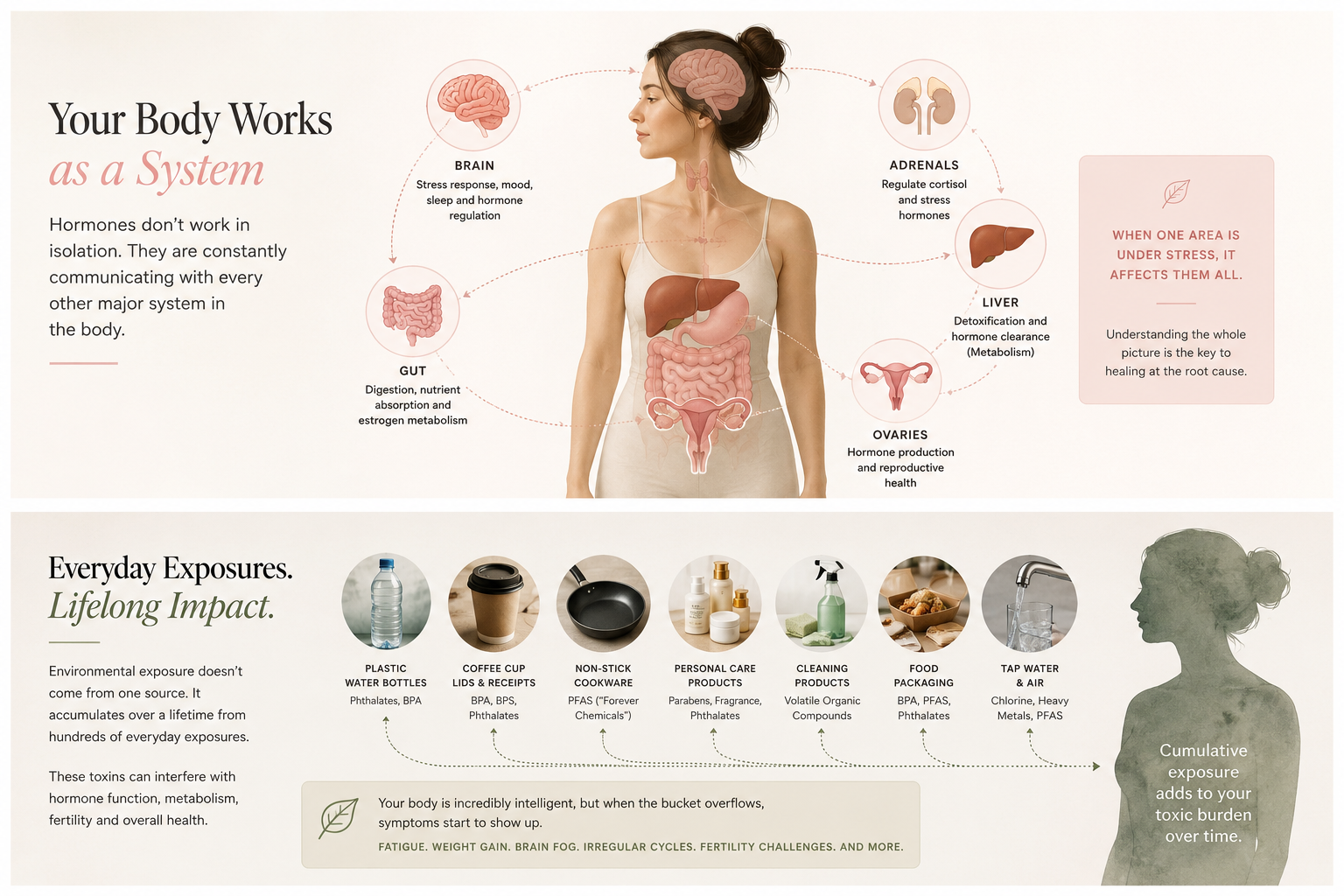
The good news is that the body is incredibly intelligent. We are not powerless against these exposures. The liver, gut, kidneys, skin, lymphatic system and lungs all play important roles in helping us process and eliminate toxins. The challenge is that different toxins often require different support strategies. Some are better eliminated through bile and the digestive system, some through urine, some through sweating and others require specific nutrients to support the detoxification pathways involved in processing them.
This is why I'm not a fan of generic detoxes.
When we understand what type of burden is present, we can be far more strategic. Sometimes the focus is supporting glutathione production. Sometimes it's improving methylation pathways. Sometimes it's supporting liver detoxification. Sometimes it's addressing gut dysfunction that's preventing the body from eliminating toxins efficiently. Sometimes it's simply reducing ongoing exposure while strengthening the body's natural detoxification capacity.
This is also where functional testing becomes incredibly valuable.
One of my favourite functional hormone tests that I now use in clinic is a comprehensive urine-based assessment that looks not only at hormone production and metabolism, but also provides insight into environmental toxin exposure, detoxification pathways, stress physiology, methylation and nutrient-dependent processes.
What I love about this test is that it allows me to see the bigger picture.
Instead of looking at hormones in isolation, I can see what may be influencing those hormones and whether environmental burden could be part of the story. It helps answer questions that standard blood testing simply can't answer. How is the body metabolising hormones? What is it doing with estrogen once it's produced? How are stress hormones affecting the picture? Are detoxification pathways struggling to keep up? Is environmental burden contributing to symptoms?
These are often the missing pieces.
The reason I prefer urine testing over hair analysis is because I want to understand what the body is actively processing and eliminating. Hair analysis has significant limitations and concerns around reliability, contamination and interpretation. Two practitioners can often look at the same hair analysis and come to very different conclusions. Personally, I've never found it reliable enough to guide clinical decision-making, which is why it's not a test I use in practice.
Urine testing, on the other hand, allows us to assess what is actively being excreted through the body's natural detoxification pathways. While no test is perfect, I find it provides significantly more clinically useful information when we're trying to understand hormone metabolism, environmental burden and how the body is managing both.
BOOK A CONSULTATION
For women who have spent years wondering why they feel exhausted, why they can't lose weight, why their cycles have changed or why they simply don't feel like themselves anymore, these insights can be incredibly powerful.
Because sometimes the answer isn't that your hormones have failed you.
Sometimes your hormones are simply responding to a body that has been carrying more stress, more inflammation and more environmental burden than anyone realised.
What I loved about this case is that it reminded me of something I see over and over again.
Symptoms are rarely random.
When a woman presents with fatigue, weight gain, missing periods, fertility challenges or mood changes, I'm not just asking what symptom she wants gone. I'm asking why her body is producing that symptom in the first place.
Because more often than not, there's a reason.
And when we find that reason, treatment becomes far more targeted, far more effective and far less frustrating.
This is exactly why I use functional testing in clinic. Not because everybody needs every test available, but because the right test at the right time can uncover information that changes the entire direction of treatment. Instead of simply identifying that hormones are low, we can begin understanding why they're low. Instead of managing symptoms, we can start investigating drivers.
If you've ever been told your blood tests are normal but you know something isn't quite right, if you're struggling with unexplained fatigue, weight gain, fertility concerns, irregular cycles or simply don't feel like yourself anymore, there may be more to the story than standard testing has revealed.
Your body is always communicating.
Sometimes we just need the right tools to understand what it's trying to say.
If you'd like support investigating your symptoms and uncovering the drivers behind them, my Health Analysis consultations and Hormone Rehab programme are designed to do exactly that. Together we look beyond the symptoms, connect the dots and create a plan that actually makes sense for your body.
Because you deserve more than being told everything is normal when you know it isn't.
BOOK A CONSULTATION
